
What Ashland County Tax Records Contain
The Catalis portal carries assessment, tax, ownership, and legal-description information for Ashland County. That is according to the county. The Real Property Lister adds acreage, values, and tax districts. It also covers parcel maps, transfer records, and mailing addresses. The Treasurer's site posts a "View Tax Information" entry point. Parcel-card labels, exemptions, tax years, and payment-status fields are not spelled out on the county pages. So treat some fields as unconfirmed until a search shows them.
| Field | What It Shows | Where |
|---|---|---|
| Assessment and value | Current assessment and value data are maintained; exact card labels are not published. | Municipal assessor sets; RPL maintains the roll. |
| Ownership and parcel | Ownership, parcel number, and legal description connect the land record. | Real Property Lister / Catalis. |
| Tax information | County portal is described for tax information; exact bill fields and year range are unknown. | Treasurer “View Tax Information” / Catalis. |
| Taxing district | Taxation-district data are listed among RPL records. | Real Property Lister. |
| Exemptions and taxable amount | Local flags and field names were not verified. | Ask the municipal assessor. |
An assessed value is not a sale price. Wisconsin assesses at full value. The Department of Revenue publishes equalized values and municipality-level ratios. Those numbers give context for the county, not a parcel appraisal. Assessed meaning and recorded sale amounts differ in important ways. For the full distinction, see the Ashland County property value page.
Ashland County Assessor and Treasurer Roles
Separate the value question from the payment question. The municipal assessor handles a parcel's assessed value, building details, and local appeals. The county Real Property Lister keeps the roll and parcel records. The Treasurer takes questions about bills, balances, receipts, and delinquency status. A corrected assessment and a posted payment are two different events. Keep the parcel number and tax year handy so either office can reconcile an account.
County and municipal duties split cleanly in Ashland County. The RPL maintains ownership and assessment data, but municipal assessors decide the assessments. For a value appeal or a building question, the county assessment page points to the local assessor. It covers the municipality where the parcel sits. Payments go through the Treasurer instead. That division spares you a common dead end. Do not ask the roll office to settle a local appeal. And do not ask an assessor to confirm a payment.
The county assessment-information page lays out the local assessor route. It names the handoff plainly. It does not list every municipal appeal date, local form, or fee.
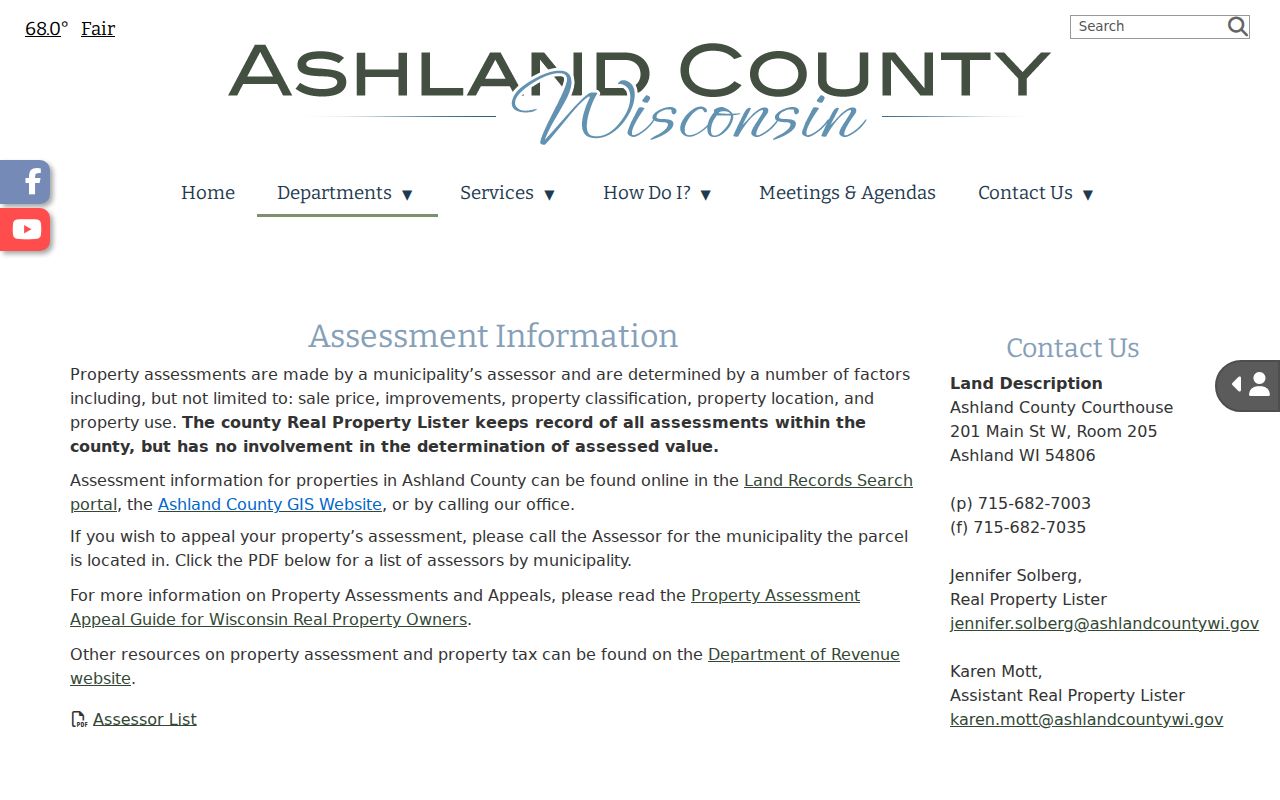
Use that county handoff to find the assessor serving the parcel. The assessor, not the RPL, explains how a value was set.
Ashland County's Guest Search Fields
Catalis in Ashland County advertises search by owner name, address, and parcel number. The county's public page shows a guest sign-in action rather than a live result form, so the search modes rest on the county's own descriptions. Formatting rules and required fields are not stated.
| Owner name | County-confirmed search mode; no required format stated. |
|---|---|
| Address | County-confirmed search mode; use the physical situs when known. |
| Parcel number | County-confirmed search mode; syntax and punctuation are not published. |
| Guest Sign In | “Accept and Sign In” is the public route shown on the portal landing screen. |
The staff username and password boxes do not mean you must create an account. The county describes public guest access, while historical coverage and export options remain unspecified.
How to Reach an Ashland County Tax Bill
Keep three dates straight when asking about a bill. These are the tax year, the payment date, and the posting date. Give the Treasurer the parcel number and the year. Hold onto any receipt or notice reference. The county publishes no single historical bill archive, online payment cutoff, or parcel-level delinquency export. If the issue is a value rather than a balance, ask the municipal assessor or RPL which value year applies. Compare amounts only after that year is clear.
Start with the Treasurer page's "View Tax Information" route. The Catalis public portal's guest access also works. An address or parcel number gets you moving. When a result is unclear, bring the parcel identifier to the Treasurer or RPL. Ask which tax year or bill record answers the question. The county does not state the portal's year range, exact bill fields, or payment fees. No delinquency-list URL is published either.
- Find the parcel in Catalis by address, owner, or parcel number.
- Open the Treasurer's “View Tax Information” route for the bill record.
- Confirm the year, parcel, mailing details, and amount with the Treasurer if the display is incomplete.
- Ask the municipal assessor about the assessment or exemption fields; do not treat an unverified blank as “none.”
- For a delinquency or tax-deed question, contact both Treasurer and RPL and verify any completed transfer with the ROD.
- Assessed value
- The assessor's value used in the property-tax system, distinct from a sale quote.
- Levy
- The amount a taxing body raises across property within its jurisdiction.
- Exemption
- A statutory tax treatment; Ashland County's local field names and flags were not confirmed.
- Tax delinquency
- Unpaid taxes handled through Treasurer and RPL processes; it is not proof of a completed tax deed.
The Ashland County Treasurer's page is the official entry point named in county research.
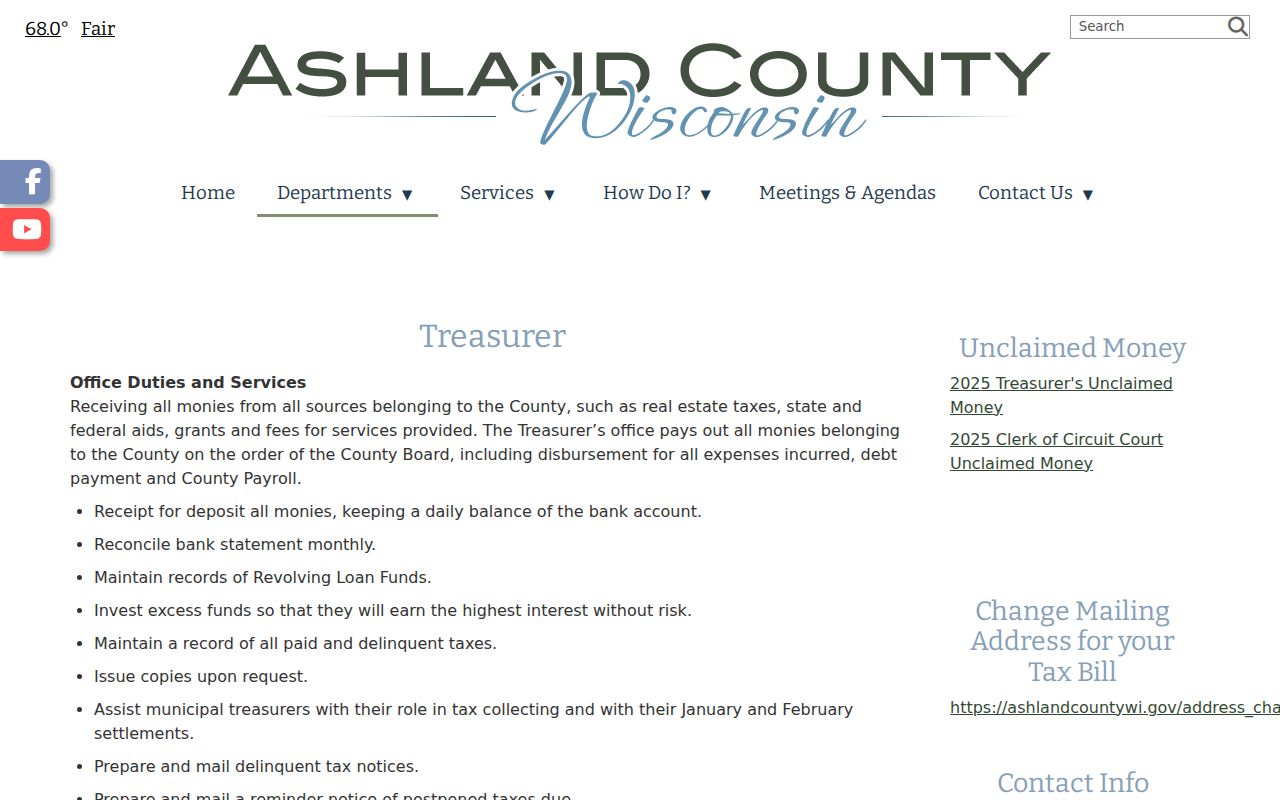
The county page shows where visitors are directed for tax information. It displays no parcel bill and does not say how many prior years are online.
Ashland County Assessments Follow a Cycle
Wisconsin's five-year rule is a ceiling, not a promise. A full-value reassessment does not sweep every Ashland County parcel in the same year, and the statute sets a maximum interval for municipal assessment work rather than a uniform inspection schedule. Read any change on the tax roll together with its assessment year and the municipality that prepared it. Those two details give the number its meaning. A building characteristic can look stale. Describe the field and the parcel to the municipal assessor, who keeps the property record behind the value. When the amount due seems wrong instead, the Treasurer reviews the bill year and the payment posting. The questions overlap, but they draw on different office records.
The state's Property Assessment Manual requires municipalities to assess at full value at least once every five years, and the Department of Revenue's 2025 update revised guidance on the assessment cycle, privacy and redaction, open book, and valuation. Ashland County publishes no countywide revaluation list. So do not guess a countywide year from a single notice or one portal value. For one parcel, ask the municipal assessor which assessment year applies. Include the market date, and ask whether an open-book review is available. The Department of Revenue also publishes statistical reports with aggregate ratios and equalized values. Those measures compare local assessments in broad terms. They never replace the parcel's own record.
Ashland County Delinquency Has a Separate Trail
The Treasurer can state the tax year, amount due, payment posting, and any current notice tied to the parcel. Ask the RPL how the county handles the related delinquency or foreclosure record. Check LandShark for a recorded instrument. Do this whenever a tax deed or notice is said to have occurred. Ashland County publishes no parcel-by-parcel delinquency export. There is also no complete redemption calendar online.
The RPL page describes hands-on staff work: foreclosure research that assists the Treasurer, notices, payment plans when applicable, and tax-deed filings. The county may also sell land taken for nonpayment of taxes through Wisconsin Surplus. Match any listing to the parcel. Then match it to the final recorded documents. Begin with the tax information route, then contact the Treasurer or RPL about the balance, its status, and the process. Ask about payment plans where they apply. WCCA may hold a foreclosure or quiet-title case tied to the parcel. A past-due amount proves nothing about the outcome. It does not show that a foreclosure finished or that title changed hands.
Ashland County Tax Mail Follows Its Own Field
The RPL maintains the tax-bill mailing field. Addresses change as part of the roll. The situs is simply where the parcel lies. That address can differ from the mailing address on the bill. A bill rerouted to a new address does not prove a conveyance. Only a recorded deed shows the transfer. By the same token, a situs address or ZIP cannot tell you who receives tax mail. When a bill points to an old owner or the wrong destination, give the RPL the parcel number. Ask how to update or verify the mailing field. For a transfer that just closed, compare the most recent recorded deed with the roll. The county publishes no fixed update-lag interval.
Where an Ashland County Assessment Appeal Starts
Start with the municipal assessor, not the county RPL. An Ashland County value appeal or building-characteristic question belongs with the assessor serving the parcel, and county instructions route these matters there. Wisconsin's assessment manual describes the assessment and open-book process, but Ashland County publishes no local hearing dates, notice period, appeal board calendar, or evidence checklist. Get the current notice before relying on a deadline.
Appeal window. Ask the municipal assessor for the current open-book and Board of Review schedule and filing instructions. The county's public assessment page does not publish one countywide date, so no deadline should be assumed.